
Samsung Exynos 2600 GPU Performance: Xclipse 960 Ray-Tracing King for Galaxy S26
In December 2025, Samsung officially unveiled its latest flagship mobile processor, the Exynos 2600. This chipset is poised to power the upcoming Galaxy S26 series in various international markets. Early performance reports have generated significant buzz, suggesting that this new System on a Chip (SoC) is ready to go head-to-head with its primary competitor, Qualcomm's Snapdragon 8 Elite Gen 5. While both chips are expected to feature in the Galaxy S26 lineup depending on the region, new benchmarks indicate that Samsung might have a significant advantage in graphical capabilities, particularly in the realm of advanced lighting effects.
- ✨ The Exynos 2600's Xclipse 960 GPU has officially become the world's fastest mobile GPU for ray-tracing.
- ✨ New benchmarks show the Samsung chip outperforming the Snapdragon 8 Elite Gen 5 by nearly 9%.
- ✨ This is the first mobile GPU to leverage AMD’s cutting-edge RDNA 4 architecture.
- ✨ The chipset demonstrates superior performance over MediaTek’s high-end Dimensity 9500.

Exynos 2600 Crushes Competition in Ray-Tracing Benchmarks
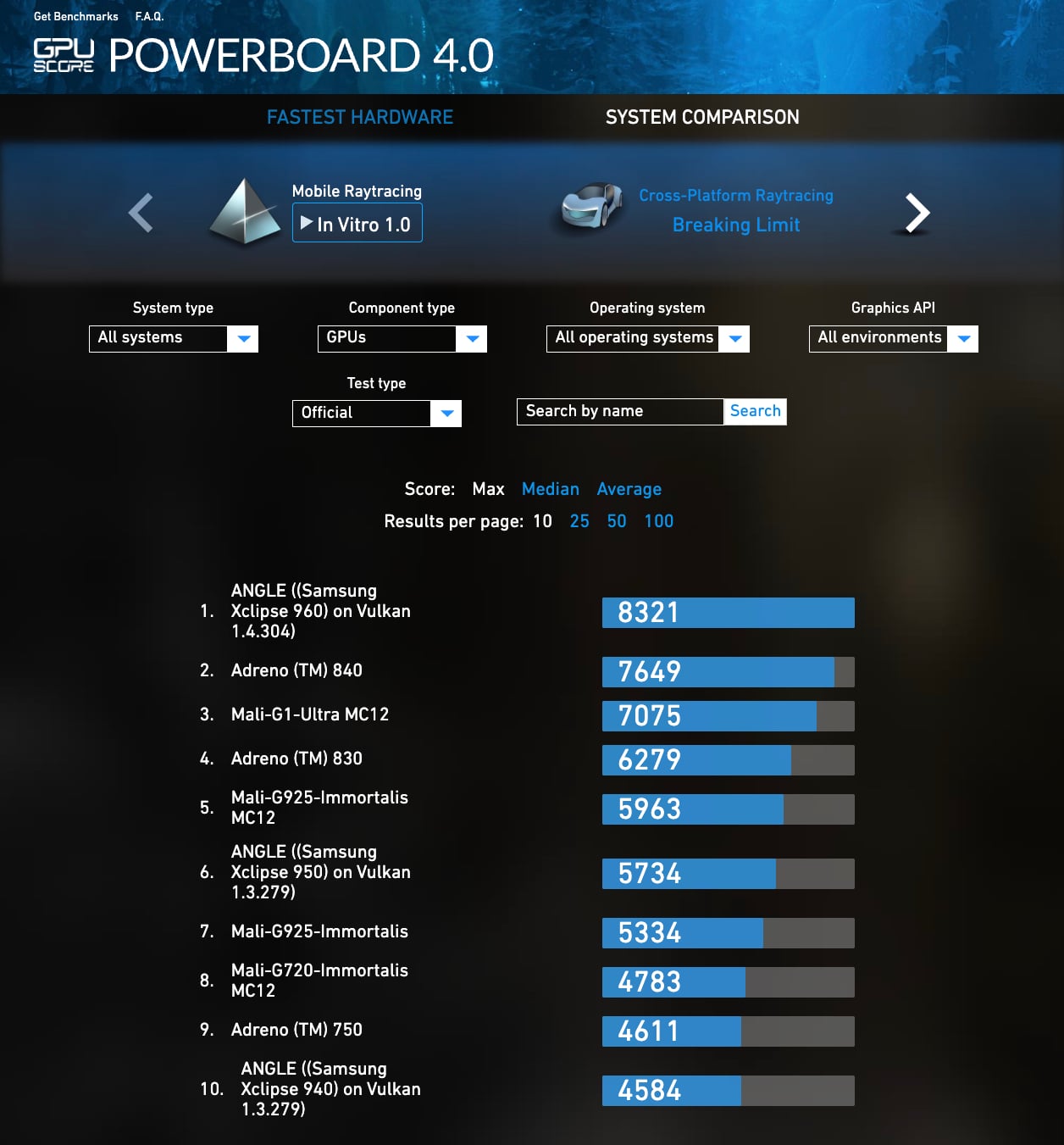
The latest data comes from the GPU Score In Vitro 1.0 Mobile Raytracing test, a benchmark specifically designed to measure how well a mobile GPU handles ray-tracing—a demanding technology that simulates realistic light, shadows, and reflections in games. In this test, the Xclipse 960 GPU inside the Exynos 2600 achieved a chart-topping score of 8,321 points. This result firmly establishes it as the most powerful mobile GPU currently available for ray-tracing tasks.
| Chipset / GPU | Ray-Tracing Score | Performance Gap |
|---|---|---|
| Exynos 2600 (Xclipse 960) | 8,321 | Baseline |
| Snapdragon 8 Elite Gen 5 (Adreno 840) | 7,649 | -8.8% |
| MediaTek Dimensity 9500 (Mali-G1 Ultra) | 7,075 | -17.6% |
When compared to other industry giants, the lead is clear. The Adreno 840 GPU found in Qualcomm’s Snapdragon 8 Elite Gen 5 trailed behind with 7,649 points, while MediaTek’s Dimensity 9500 followed with 7,075 points. This translates to the Samsung chipset being approximately 8.8% faster than its Qualcomm rival and a massive 17.6% faster than MediaTek's offering in this specific graphical category.
The Power of AMD RDNA 4 Technology
The secret to the Exynos 2600’s success lies in its architecture. The Xclipse 960 is the world's first mobile GPU to implement AMD’s RDNA 4 technology. Samsung’s decision to continue its partnership with AMD rather than using standard ARM Mali designs seems to have paid off handsomely. RDNA 4 brings desktop-class graphical efficiencies to the palm of your hand, ensuring that the Galaxy S26 will be an absolute powerhouse for mobile gaming and high-fidelity rendering.
What makes the Exynos 2600 different from previous Samsung chips?
The Exynos 2600 is the first to utilize the Xclipse 960 GPU based on AMD’s RDNA 4 architecture. This allows for significantly better power efficiency and a massive jump in ray-tracing performance compared to the Exynos 2400 or competitors using older GPU designs.
Will all Galaxy S26 models use the Exynos 2600?
Typically, Samsung uses a dual-chip strategy. While many regions will likely see the Exynos 2600, others (like the US and China) might receive the Snapdragon 8 Elite Gen 5. However, these new benchmarks suggest that Exynos users might actually have the edge in graphics performance this year.
Why is ray-tracing performance important for smartphones?
Ray-tracing is the future of mobile gaming. It allows for ultra-realistic lighting and shadows that were previously only possible on high-end PCs and consoles. As more mobile games support this feature, having a powerful GPU like the Xclipse 960 becomes vital for an immersive experience.
How does the Exynos 2600 compare to the Snapdragon 8 Elite Gen 5?
In specialized ray-tracing benchmarks, the Exynos 2600 is nearly 9% faster than the Snapdragon 8 Elite Gen 5. While raw CPU speeds may vary, Samsung's partnership with AMD has given them a clear lead in the specialized area of graphics processing.
🔎 The emergence of the Exynos 2600 as a graphical leader marks a significant turning point for Samsung's semiconductor division. By leveraging AMD's RDNA 4 architecture, Samsung has successfully addressed one of the biggest criticisms of its previous chips: graphical performance. As we approach the official launch of the Galaxy S26 series, it is clear that mobile gamers and tech enthusiasts have a lot to look forward to. Whether you are interested in realistic lighting in games or smooth multitasking, the Exynos 2600 appears ready to deliver a truly flagship-grade experience that finally puts the "Exynos vs. Snapdragon" debate in a new light.
Post a Comment