
Galaxy Quick Share to Adopt AirDrop-Style Security Limits for Enhanced Privacy
The way we share files wirelessly on our mobile devices is about to become more secure. In an effort to align more closely with industry standards and improve user privacy, Google is introducing new limitations to the Quick Share feature. This update, which has already begun appearing on select devices, is expected to roll out to Samsung Galaxy phones and tablets in the near future, fundamentally changing how visibility settings work for public transfers.
- ✨ Google is removing the permanent "Everyone" visibility option in Quick Share to bolster security.
- ✨ The new "Everyone for 10 Minutes" limit directly mirrors Apple's AirDrop functionality.
- ✨ This change aims to prevent "blue-snarfing" and unsolicited file requests from strangers.
- ✨ Galaxy users can expect this update via Google Play Services or upcoming One UI releases.
A few months ago, Google made a major move by making Quick Share on select Android phones compatible with Apple’s AirDrop. This cross-platform interoperability is a massive win for users who live in multi-device households. However, with great connectivity comes the need for tighter security. To address this, Google is implementing a restriction that prevents devices from being indefinitely discoverable by everyone nearby.
The End of Permanent Public Visibility
Recent reports from industry insiders indicate that Google has modified the privacy settings within the latest beta version of Google Play Services. Specifically, on Pixel 10 devices, the "Everyone" mode has been replaced with "Everyone for 10 Minutes." This means that once the ten-minute window expires, the device automatically reverts to a more private mode, such as "Contacts" or "Your Devices."
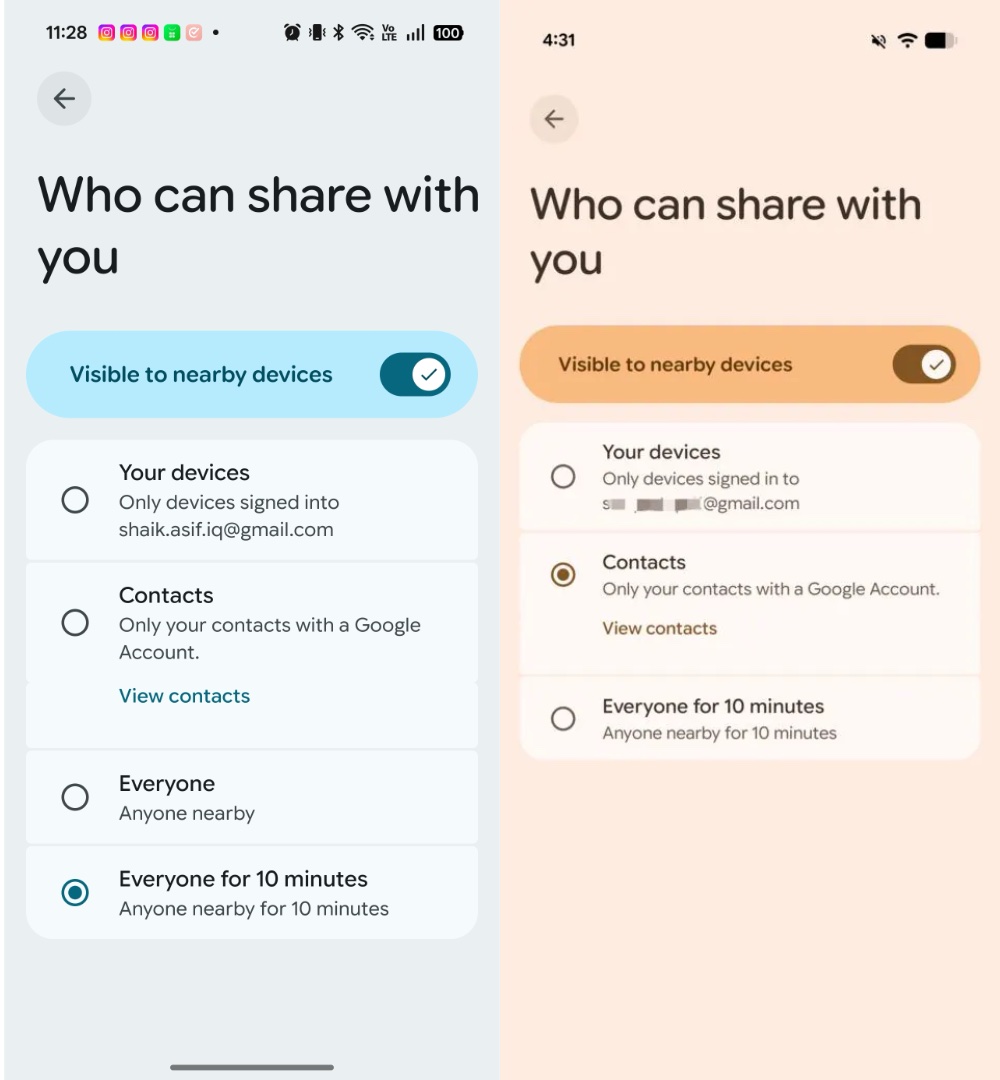
Quick Share Privacy Settings: The transition from permanent visibility to a timed window.
The move effectively eliminates the risk of users forgetting they left their sharing settings open, which could lead to receiving inappropriate content or being tracked in public spaces. This behavior is identical to how Apple manages AirDrop, a standard that was adopted after similar privacy concerns were raised globally.
What This Means for Galaxy Users
Currently, most Samsung Galaxy devices still allow users to toggle off the "Only for 10 Minutes" restriction, keeping the phone visible to everyone indefinitely. However, as Samsung works closer with Google to unify the Quick Share experience, this legacy option is likely on the chopping block. We may see this change arrive with the rollout of One UI 8.5 or One UI 9 later this year.
Strategic Alignment with Apple Interoperability
The timing of this change is not accidental. By adopting the same security protocols as AirDrop, Google and Samsung reduce the friction for Apple to maintain compatibility. If Android devices were seen as "less secure" due to permanent open sharing, Apple could theoretically use that as a justification to block cross-platform transfers. By mirroring these limitations, the Android ecosystem presents a unified, secure front that meets international regulatory expectations for open yet safe data transfers.
Why is the Everyone option being restricted to ten minutes?
The restriction is a security measure designed to prevent "digital harassment" and unsolicited file transfers. By limiting public visibility to a short window, users are less likely to leave their devices vulnerable to strangers in crowded public areas.
Will I still be able to share files quickly with my own tablet or laptop?
Yes. The "Your Devices" and "Contacts" settings remain unchanged. If both devices are signed into the same Google or Samsung account, sharing will remain instantaneous and will not require the 10-minute public toggle.
Is this change mandatory for all Android phones?
While it is currently appearing in Google Play Services beta, it is expected to become the standard for all Android devices that use the unified Quick Share system, including those from Samsung, Pixel, and OnePlus.
When will my Samsung Galaxy phone get this update?
The update is rolling out via server-side changes in Google Play Services. While some users might see it soon, a full integration into the system settings is expected with the next major One UI update.
🔎 Ultimately, while some users may miss the convenience of permanent discoverability, the transition to a timed visibility window is a necessary step for mobile security. It brings the Android ecosystem in line with global privacy standards and ensures that features like Quick Share remain a safe, reliable tool for everyone. As we move toward a more interconnected digital world, these small adjustments play a vital role in protecting our personal data from unwanted intrusions.
Post a Comment