
Samsung Exynos Chipsets Expand Market Share Amidst Global SoC Shipments Decline
Despite a general downturn in the global semiconductor market driven by surging memory costs, Samsung Exynos processors have managed to buck the trend. Industry analysts reveal that Samsung successfully increased its market footprint over the past year, thanks largely to strategic product lineups and strong consumer demand.
- ✨ Rising memory chip costs have increased overall smartphone prices, subsequently softening global consumer demand.
- ✨ Counterpoint Research data shows Samsung's Exynos market share climbed to 8% in the first half of 2026.
- ✨ Samsung stands out as one of only three major chipset vendors to achieve year-over-year growth.
- ✨ The launch of the dual-processor Galaxy S26 series significantly bolstered Exynos adoption rates.
Counterpoint Research Highlights Exynos Growth
Escalating memory chip prices have forced manufacturers to drive smartphone prices higher, directly resulting in a softer market demand. Consequently, overall mobile chipset shipments experienced a noticeable decline. Nevertheless, Samsung's proprietary Exynos system-on-chip (SoC) lineup defied expectations by capturing a larger share of the global market.
According to a published market analysis report from Counterpoint Research focusing on the first half of 2026, Samsung's chipsets secured an 8% market share. This reflects an impressive growth from the 5% recorded during the same period in 2025.
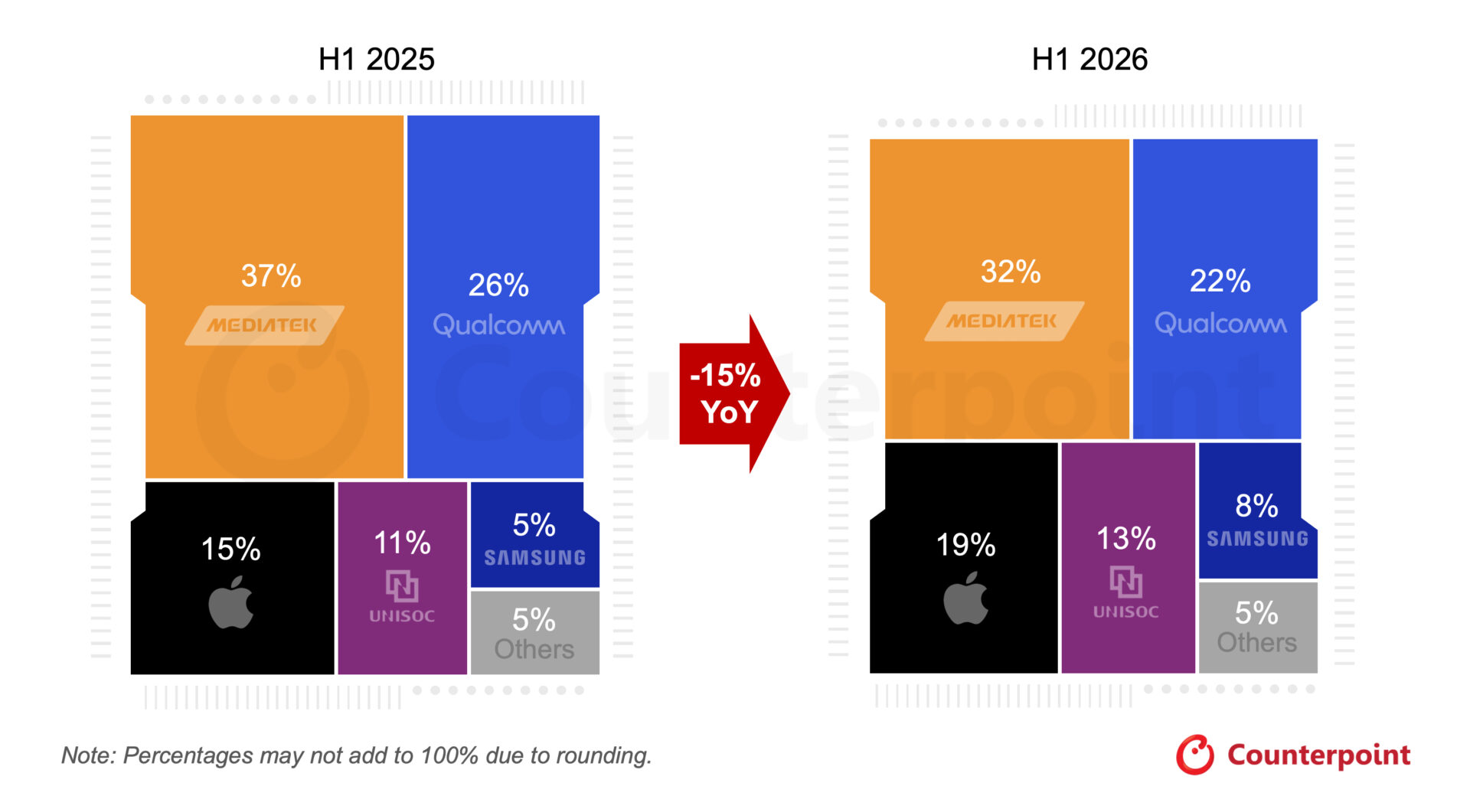
Amidst a shrinking sector, Samsung positioned itself alongside only two other chipset vendors—Apple and Unisoc—capable of expanding their year-over-year market presence.
The Impact of the Galaxy S26 Series
A primary driver behind this resurgence was Samsung's hardware strategy for its flagship release. Unlike its predecessor, the Galaxy S25 lineup, which relied exclusively on Qualcomm Snapdragon components, the Galaxy S26 series adopted a hybrid approach. By integrating both Qualcomm Snapdragon and Samsung Exynos processors across the lineup, combined with robust retail sales, Samsung successfully propelled its in-house chipsets back into a growth trajectory.
What caused the global decline in smartphone chipset shipments?
Rising memory chip manufacturing costs have pushed retail smartphone prices higher, which has cooled consumer demand and led to lower overall device sales.
What was Samsung Exynos's market share in H1 2026?
Samsung's Exynos processors achieved an 8% market share in the first half of 2026, growing from 5% during the same timeframe in the previous year.
Which companies managed to grow their chipset market share?
Counterpoint Research data indicates that Samsung, Apple, and Unisoc were the sole chipset vendors to experience year-over-year market expansion.
How did the Galaxy S26 series influence Exynos adoption?
Unlike the previous generation that relied solely on Snapdragon processors, the Galaxy S26 series featured a split model strategy utilizing both Exynos and Snapdragon chips, directly boosting Exynos shipment volumes.
🔎 Ultimately, Samsung's tactical hardware decisions and diversified component strategy have proven effective in navigating a challenging macroeconomic environment. By capturing a larger slice of the global SoC pie, Exynos has demonstrated resilience and renewed competitiveness in the modern mobile landscape.
Post a Comment