
Samsung Launches "Samsung RX": A New Era of Robotics and Humanoid Innovation
Samsung Electronics has officially signaled its intent to dominate the future of automation by establishing a dedicated robotics division known as Samsung RX. This strategic move aims to consolidate the tech giant's robotics research and development under a single, powerful banner, focusing on creating both specialized and multipurpose robots for the global market. To stay updated on the latest tech shifts, you can click here to see more Samsung Electronics news.
- ✨ Samsung establishes a dedicated "Samsung RX" division to spearhead robotics growth.
- ✨ Former Hyundai and Boston Dynamics expert Lee Dongkun will lead the new unit.
- ✨ The division will focus on humanoid robots and manufacturing automation first.
- ✨ Global R&D hubs are being launched in the US, China, and Japan to attract top talent.
The newly formed RX Business Promotion Office will operate under the direct and personal supervision of TM Roh, the CEO of Samsung DX. By placing this division under top-tier leadership, Samsung is emphasizing that robotics is no longer just a side project but a core pillar of its long-term survival and expansion strategy.
World-Class Leadership and Global Research Hubs
Leading the charge for Samsung RX is Vice President Lee Dongkun. Lee is a seasoned veteran in the field, having previously directed robotics strategy at Hyundai Motor Group and its world-famous subsidiary, Boston Dynamics. His expertise is expected to provide Samsung with the roadmap necessary to transition from experimental prototypes to commercially viable robotic solutions. To learn more about the executive team, [Click here to view TM Roh's profile].
To ensure a steady stream of innovation, Samsung is also recruiting elite academic talent. Renowned professors such as Hyun-Jin Kim from Seoul National University and Eui-Kyum Kim from Ajou University—experts in robot manipulation and hand mechanics—are joining the team. The primary development hub will be located at the Seoul R&D Campus in Umyeon-dong, supported by satellite R&D centers in the United States, Japan, and China.
From Factory Floors to Your Living Room
The strategy for Samsung RX is methodical. The company plans to first deploy manufacturing and logistics robots within its own global factories. This internal rollout will serve as a massive data-collection exercise, allowing Samsung to refine its AI and hardware in a controlled environment. Once the technology is perfected, Samsung will move into the B2B market, selling these industrial solutions to other firms, before finally entering the retail and home-use sectors.
A significant part of this development involves the humanoid robot segment. Samsung has expressed its desire to make "substantial progress" in humanoid technology this year. To support this, a specialized "data factory" at the Gumi plant in South Korea will be used to feed massive amounts of operational data into Samsung’s robot intelligence engines.
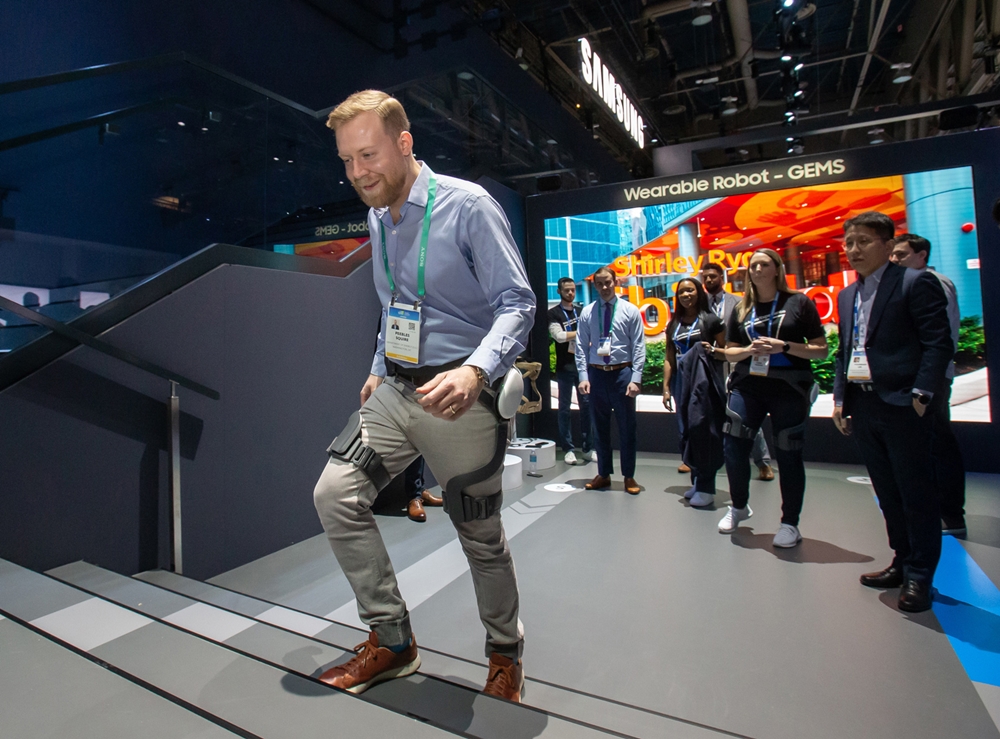
This move also breathes new life into older projects. For instance, the GEMS (Gait Enhancing & Motivating System), a wearable robotic exoskeleton first showcased at CES 2020, may finally see a commercial release under the RX banner. Originally intended for the elderly and those with mobility issues, GEMS represents Samsung’s vision of robots that directly assist human physical capabilities.
What exactly is the purpose of the new Samsung RX division?
Samsung RX was created to centralize all of Samsung's robotics efforts. Its primary goal is to develop advanced robotic technologies, starting with industrial and logistics applications for Samsung's own factories, and eventually expanding into commercial and consumer robots, including humanoid models.
Who is leading this new robotics initiative?
The division is headed by Lee Dongkun, a former executive from Hyundai Motor Group and Boston Dynamics. It is being personally overseen by TM Roh, the CEO of Samsung’s DX (Device eXperience) division, highlighting its importance to the company's future.
Where will Samsung's robotics research take place?
The main hub is the Seoul R&D Campus in South Korea. However, Samsung is establishing a global network of R&D centers in the US, China, and Japan to tap into international talent and different technological ecosystems.
Will we see Samsung robots in our homes anytime soon?
While the initial focus is on manufacturing and logistics to refine the technology and collect data, Samsung has confirmed that its long-term roadmap includes developing and selling robots for retail environments and residential use.
What happened to the GEMS exoskeleton project?
Although the GEMS wearable robot was delayed after its 2020 debut, the creation of Samsung RX suggests that these types of assistive technologies will now be integrated into a broader, more organized development pipeline for eventual commercialization.
🔎 In conclusion, the formation of Samsung RX marks a pivotal moment in the company's history, transitioning from a consumer electronics leader to a pioneer in the robotics age. By combining veteran leadership from the likes of Boston Dynamics with a global R&D network and internal factory testing, Samsung is positioning itself to be a dominant force in the next generation of AI-driven automation. Whether in the factory or the home, the age of Samsung robotics appears to be officially underway.
Post a Comment