
Samsung Secures 39% Market Share to Maintain Position as World's Leading DRAM Manufacturer
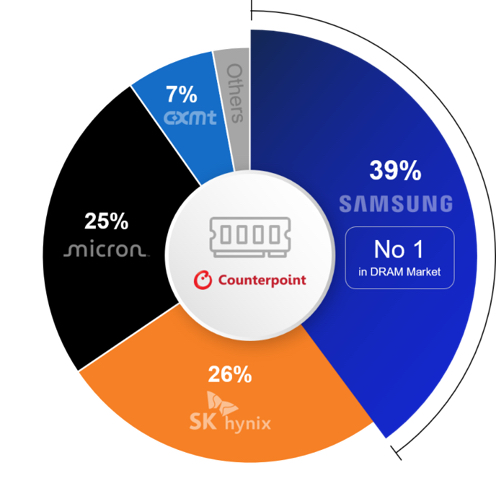
Counterpoint Research has recently shared its comprehensive findings regarding the global DRAM market for the second quarter of 2026. According to the published data, Samsung has successfully retained its dominant position by capturing an impressive 39% market share. This accomplishment marks the third quarter in a row that the South Korean technology giant has comfortably outperformed its competitors in the global semiconductor landscape.
Key Takeaways
- ✨ Samsung dominated the global DRAM market in Q2 2026 with a massive 39% share, marking three consecutive quarters at the top.
- ✨ SK Hynix secured the second position with 26% of the market share, followed closely by Micron at 25% and CXMT at 7%.
- ✨ The tech giant successfully expanded its lead over competitors by capitalizing on surging general-purpose DRAM prices and strengthening its high-bandwidth memory footprint.
Expanding the Lead Over Competitors
Since reclaiming the crown in the semiconductor industry, Samsung has consistently widened the competitive gap between itself and its closest rivals. SK Hynix currently holds the second-place standing with a 26% market share for Q2 2026. Meanwhile, Micron and CXMT trail behind with respective market shares of 25% and 7%, highlighting Samsung's commanding lead in the sector.
Market analysts point out that Samsung's ongoing success was primarily propelled by the rising market prices for general-purpose DRAM modules throughout the quarter. Additionally, the company significantly broadened its operational footprint within the highly competitive high-bandwidth memory (HBM) arena.
This resilience was demonstrated despite facing certain market headwinds, such as declining average selling prices driven by lower HBM3E rates and minor delays involving HBM4 component shipments. Looking ahead, industry experts anticipate a swift recovery in HBM pricing by the third quarter of 2026, largely stimulated by the rollout and initial shipments of advanced hardware like Nvidia's Vera Rubin and AMD's Instinct MI455X graphics processing units.
What drove Samsung's success in the Q2 2026 DRAM market?
Samsung benefited heavily from the increasing market prices of general-purpose DRAM modules alongside an expanded presence in the specialized high-bandwidth memory sector.
Who are Samsung's main competitors in the global DRAM industry?
SK Hynix is Samsung's closest competitor with 26% of the market share, followed by Micron holding 25% and CXMT capturing 7%.
What is expected to happen to high-bandwidth memory prices next?
Industry experts expect HBM prices to experience a healthy rebound in the third quarter of 2026 due to upcoming shipments of next-generation high-performance GPUs.
🔎 Ultimately, Samsung's strategic market positioning, diverse technological offerings, and ability to navigate price fluctuations ensure its continued reign at the pinnacle of the global memory manufacturing ecosystem, paving the way for sustained leadership in upcoming technological eras.
Post a Comment