
Huawei Unveils Revolutionary 3D Data Center Featuring 100,000 Ascend Supernodes
Huawei has officially introduced the world's first 3D data center architecture, aiming to completely transform artificial intelligence infrastructure. By utilizing an innovative vertical stacking framework and massive computing clusters, the company is addressing the growing global demand for high-performance AI processing capabilities and tackling critical spatial and thermal challenges in modern tech facilities.
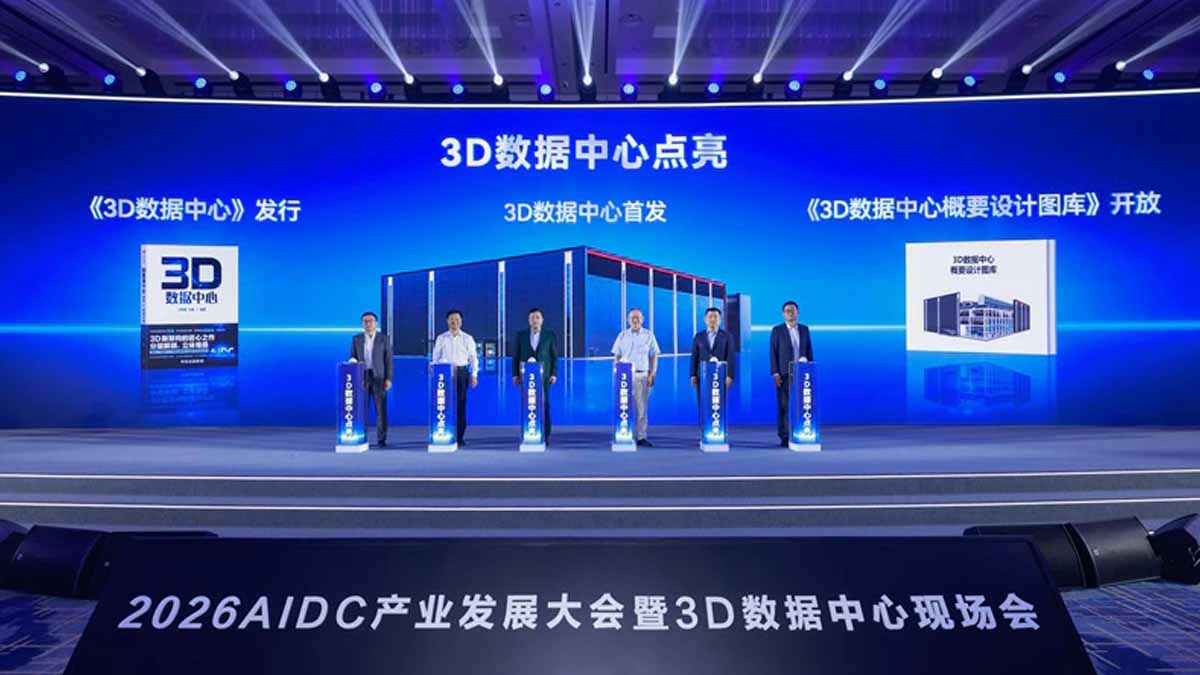
- ✨ Huawei launched the globe's inaugural 3D data center at the 2026 AIDC Industry Development Conference in Wuhu, Anhui.
- ✨ The advanced facility integrates 100,000 Huawei Ascend supernode cards within a unique four-layer vertical framework.
- ✨ The structural design successfully tackles high-density computing power hurdles like cooling, space limitations, and power distribution.
- ✨ Alongside the hardware architecture, Huawei introduced an extensive Design Library to serve as an industry reference.
Innovative Four-Layer Structural Framework
The technology giant developed this next-generation Data Center using an impressive 100,000 Huawei Ascend supernode cards coupled with a revolutionary system architecture. Rather than spreading horizontally like traditional facilities, this design stacks various functional operational spaces vertically to optimize efficiency and safety.
Technical details outline that this innovative quad-layer formation consists of:
- A cooling layer
- IT equipment layer
- Power Supply layer
- Backup Power layer
This layout specifically targets security challenges commonly found in large-scale artificial intelligence computing hubs. Furthermore, the 3D data center effectively resolves compatibility hurdles that often arise when combining different AI chips within a unified cluster environment.
Wang Tao, the Deputy Chairman and Rotating Chairman, noted that the new facility fully supports a supercomputing factory of Ascend supernode clusters through layered decoupling and three-dimensional stacking. He further explained:
"The massive model with trillions of parameters and the rapidly growing demand for tokens place higher demands on AI infrastructure. Ascend supernode clusters with over 100,000 cards will become the basic configuration."
Consequently, this establishment serves as an essential reference architecture for the wider technology industry aiming to build high-capacity supernode clusters.

Ren Shulu, the Senior Vice President and Executive Supervisor of Huawei, highlighted that high-density computing power has historically posed severe difficulties for conventional data centers regarding physical space, uninterrupted power supply, and thermal management.
Modern cabinet power levels have surged to between 100 kilowatts and 200 kilowatts, with projections indicating even higher future demands. Fortunately, the new 3D data centers successfully deliver high reliability through isolated partitions that prevent fault propagation, exceptional heat dissipation, superior energy efficiency, and vertical power routing with minimal distance.
Additionally, Huawei unveiled the comprehensive 3D Data Center Overview Design Library, spanning five key areas: Computing Power, Transformation, DC Reconstruction, Value Leap, Masterpiece, and Paradigm Shift. This extensive library covers crucial structural elements including water supply, HVAC systems, and high or low-voltage electrical frameworks.
What makes the Huawei 3D data center unique?
It is the world's first data center architecture to utilize a vertical four-layer stacking framework combined with 100,000 Huawei Ascend supernode cards to solve space and cooling issues.
What are the four layers of the 3D data center?
The quad-layer setup consists of a cooling layer, an IT equipment layer, a power supply layer, and a backup power layer arranged vertically from top to bottom.
How does this architecture handle high energy demands?
The vertical structure allows for extremely short power and cooling routing, offering high energy efficiency and superior thermal management for cabinets consuming 100 to 200 kilowatts.
What is the purpose of the 3D Data Center Overview Design Library?
It acts as a complete reference guide covering water supply, HVAC systems, electrical engineering, and computing power transformation for building future supernode facilities.
🔎 Conclusion: Huawei's introduction of the world's first 3D data center marks a monumental leap forward in artificial intelligence engineering. By seamlessly integrating 100,000 Ascend supernodes within a vertically decoupled framework, the company has effectively solved critical density, thermal, and spatial roadblocks. This breakthrough infrastructure not only sets a brand new benchmark for computing factories worldwide but also paves the way for sustainable, high-performance AI growth in the years to come.
Post a Comment