
The CyberOne Revolution: How Xiaomi’s Humanoid Robot Exceeded Expectations in Automotive Factories
The global automotive industry is undergoing a radical transformation with the integration of advanced technologies into production lines, but what Xiaomi recently achieved goes far beyond traditional automation. The CyberOne humanoid robot has proven that the future is no longer distant, as it has already begun mimicking human performance with staggering precision inside complex manufacturing environments, unlocking new horizons for production efficiency in the electric vehicles sector.
- ✨ A massive leap in task success rates from 90.2% to 98% in a short period.
- ✨ Superior ability to handle flexible parts and adjust movements in real time within the factory environment.
- ✨ Clear superiority in long-duration operation tests compared to competitors in the robotics sector.
- ✨ Narrowing the production gap with human workers to just 1% in specific tasks.
Staggering Evolution in Sensory Perception and Motion Algorithms
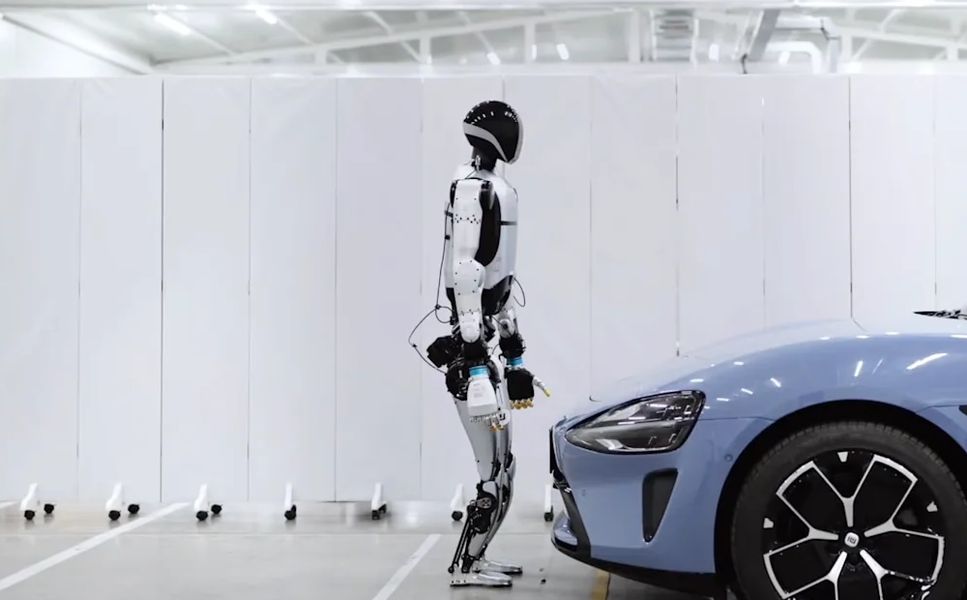
Over the past few months, Xiaomi’s humanoid robot known as CyberOne achieved an unprecedented technological breakthrough while operating in one of the company's automotive plants. In early 2026, the robot was assigned the task of loading self-tapping nuts on the electric vehicle assembly line, where its success rate at the time was close to 90.2%. However, thanks to continuous improvements in artificial intelligence and perception algorithms, this rate climbed to 98% within just four months.
This success is not limited to numbers alone, but extends to the robot's ability to adapt to real factory conditions, such as continuous vibrations and shifting mechanical parts. The performance gap between CyberOne and human workers in this delicate task has become extremely narrow, separated from human efficiency by only one percentage point, reflecting the maturity of the technologies developed by Xiaomi Corporation.
The Challenge of Flexible Parts and Complex Manufacturing Tasks
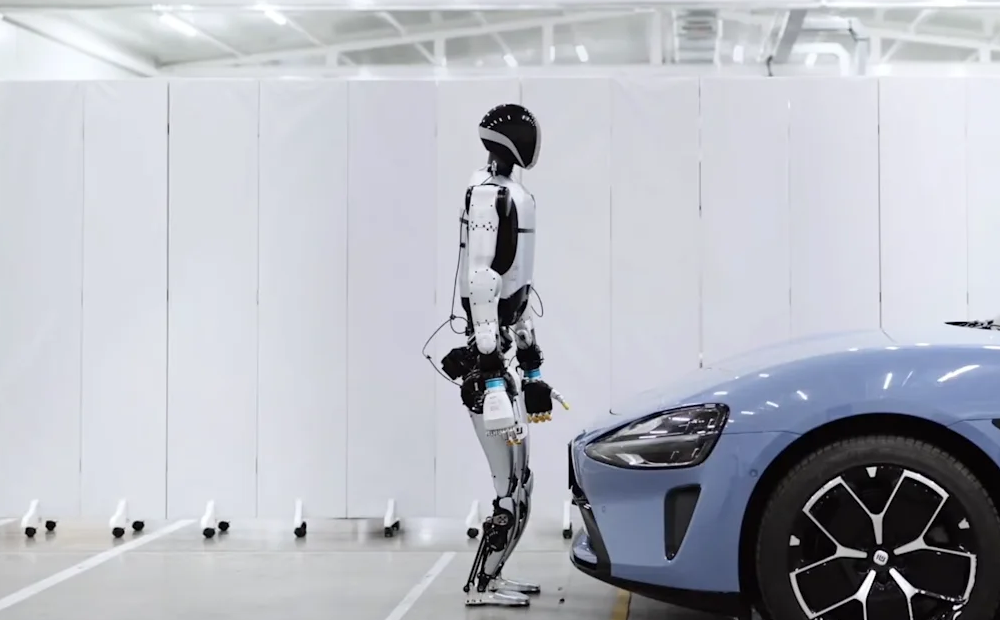
Xiaomi did not stop at a single task; it expanded the robot's testing scope to include sorting side panels for central control units, as well as folding and recycling parts boxes. Although the success rate in these tasks reached 90%, handling flexible parts was the greatest challenge. Deformable parts require ultra-high precision visual perception and a strong capability to adjust motion trajectories within fractions of a second. CyberOne proved high efficiency here as the first humanoid robot to work for extended periods with non-rigid parts in an industrial environment.
Global Competition: From Laboratories to Actual Production Lines
As Xiaomi advances, other companies such as Figure and AgiBot strive to prove their worth. Figure showcased the capabilities of its Figure 02 robot through a live stream lasting over twenty hours, where the robot demonstrated complete autonomy in transporting items and handling logistical tasks inside warehouses with negligible human intervention.
On the other hand, AgiBot presented an impressive model through its G2 robot, which worked for 64 consecutive hours on a tablet production line. During this period, the robot executed over 64,000 tasks and contributed to producing more than 17,000 devices with a phenomenal success rate of 99.99%. These numbers confirm that the era of humanoid robots has moved from demonstrations to real, sustainable industrial operations.
What is the success rate achieved by the CyberOne robot in Xiaomi factories?
The robot achieved an incredible success rate of 98% in the nut-loading task, bringing it very close to human worker efficiency, which outperforms it by only 1%.
Why is handling flexible parts considered a major technological achievement?
Because flexible parts are prone to deformation and shifting positions easily, requiring the robot to possess an advanced computer vision system and the ability to make immediate corrective movement decisions, which is much harder than handling rigid objects.
How does CyberOne's performance compare with competing robots like AgiBot G2?
While CyberOne focuses on precision in complex automotive assembly tasks, AgiBot G2 demonstrated exceptional long-term endurance with a 99.99% success rate in electronics manufacturing, pointing to the diverse specializations of humanoid robots in industry.
Can these robots work completely autonomously?
Yes, recent experiments—especially with the Figure 02 robot—demonstrated the ability of these machines to operate completely independently in picking and transferring items while self-adapting to surrounding variables without human intervention.
🔎 In conclusion, the rapid evolution of Xiaomi's CyberOne and its counterparts across global companies represents a pivotal turning point in modern manufacturing history. Reaching precision close to human performance in complex industrial tasks is not merely an engineering achievement, but an announcement of a new era where mechanical power and human intelligence integrate to raise quality and productivity standards to unprecedented levels, changing the face of traditional factories forever.
Post a Comment