
The Truth Behind the Mother of All Bombs: MOAB's Devastating Power and the Massive Afghanistan Strike
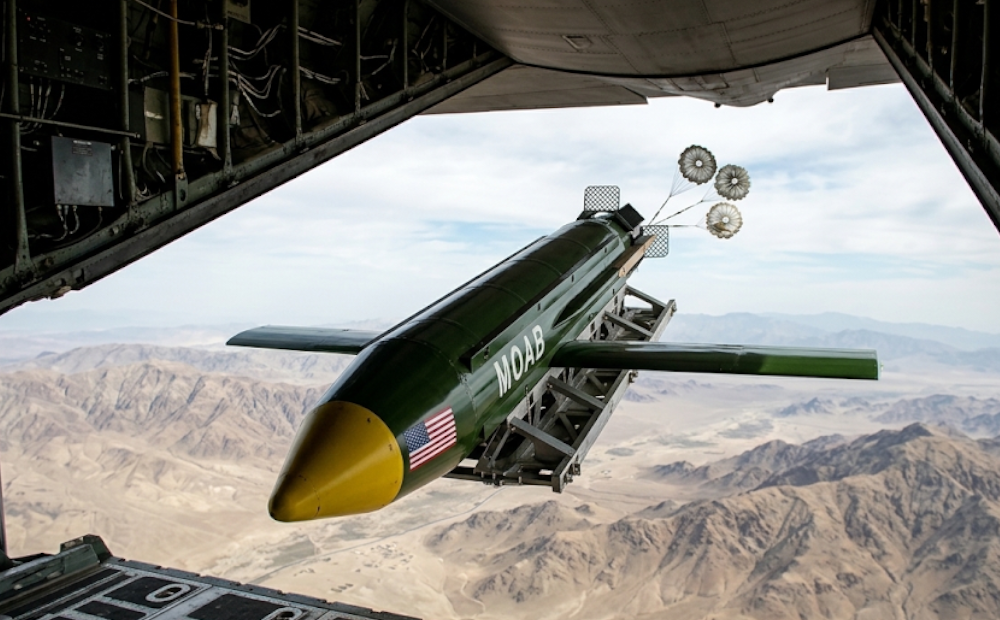
The "Mother of All Bombs" reigns supreme in the U.S. military arsenal as the largest non-nuclear conventional weapon ever used in the history of modern warfare. Formally designated as the GBU-43/B, its famous acronym MOAB stands for Massive Ordnance Air Blast. This moniker naturally evolved into the "Mother of All Bombs" due to its horrifying destructive power, designed to annihilate everything on the surface and directly underground through inescapable shockwaves.
Article Summary in Quick Points:
- ✨ Targeting complex ISIS tunnel networks across rugged Afghan terrain.
- ✨ Relying on an air blast to devastate an area with a radius of up to 1.5 kilometers.
- ✨ Weighing approximately 10 tons and carrying a massive payload of high-explosive H-6 material.
- ✨ Delivering a major psychological and military impact, though it did not instantly eradicate the organization.
Why Washington Deployed This Lethal Weapon in 2017
On April 13, 2017, the mountains of the Achin district in Nangarhar Province, Afghanistan, shook under the weight of this bomb's first combat deployment. The objective was clear: obliterate a complex network of caves and tunnels utilized as a stronghold by ISIS-Khorasan near the Pakistani border. This region represented a military nightmare due to landmines and natural fortifications, prompting the U.S. leadership to employ terrifying military technology to minimize troop casualties and clear the area with a single decisive blow.
The Engineering and Technical Mechanics of the MOAB Drop
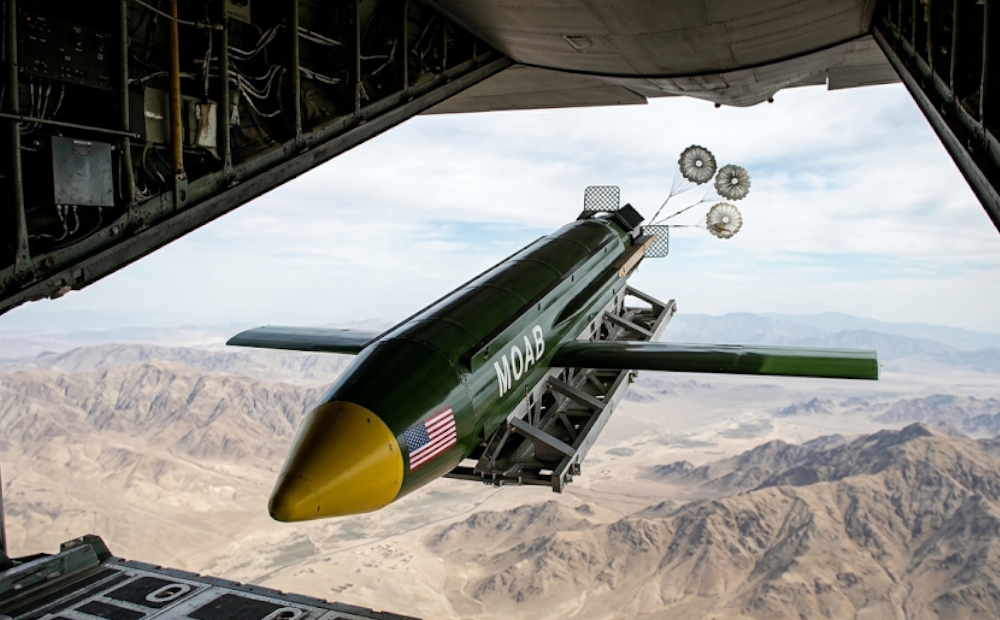
The MOAB is not dropped from standard fighter jets; instead, the massive MC-130 cargo aircraft handles this mission. The bomb is pulled from the rear of the aircraft via a specialized pallet, and once released into the air, guidance fins and a Global Positioning System (GPS) guide its massive bulk toward the target with pinpoint accuracy. What sets it apart is its detonation a few meters above the ground, creating a terrifying mushroom cloud and distributing blast pressure horizontally to sweep away everything in its path.
Despite its sheer size, lethal weapons of this class are not designed to penetrate deep rock formations like the GBU-57. Instead, their focus lies on collapsing cave entrances and generating a shockwave that neutralizes living organisms inside tunnels close to the surface through a sudden drop in pressure.
Astonishing Technical Specifications of the GBU-43/B Bomb
This giant bomb weighs approximately 9.8 tons and reaches a length of nearly nine meters. The beating heart of this metallic monster consists of 8.5 tons of H-6 explosive material, which far exceeds traditional gunpowder in sheer power. The bomb casing is engineered to be thin, allowing maximum energy to disperse as a blast wave rather than wasting energy fragmenting metal into shrapnel, making it the ideal weapon for open spaces and mountain valleys.
Beyond the Blast: Did the Strike Achieve Its Objectives?
The strike achieved global media and military resonance, demonstrating the United States' capacity to reach the most heavily fortified and rugged terrains. However, field reports indicate that ISIS-Khorasan was not eradicated by a single strike, as clashes in Nangarhar province persisted for years afterward. The organization only retreated significantly by 2019 following continuous ground and air operations involving multiple forces. This confirms that the "Mother of All Bombs" served as a formidable tactical and psychological tool, but it was not a magical solution to end the conflict.
What scientific principle does the Mother of All Bombs rely on to destroy targets?
The bomb relies on an air blast, detonating prior to impact to generate a massive pressure wave that spreads laterally. This leads to the destruction of surface facilities and suffocates individuals inside shallow tunnels due to the violent barometric pressure shift.
Does the MOAB bomb leave behind any radioactive residue after detonation?
No. Although the explosion resembles a nuclear mushroom cloud, it is a completely conventional bomb utilizing chemical explosives (H-6) and contains no nuclear or radioactive materials.
Why isn't this bomb used frequently in warfare?
Because of its massive size, which requires slow, non-combat cargo aircraft to deploy it—making them vulnerable in airspace defended by advanced anti-aircraft systems—alongside its high cost and widespread indiscriminate impact.
How is a 10-ton mass guided accurately toward its target?
This is achieved through advanced navigation systems including GPS and inertial navigation, alongside grid fin controls that deploy after release to correct its free-fall trajectory toward designated coordinates.
Can the MOAB penetrate deep underground bunkers?
No, it is primarily an air-burst weapon designed to devastate surface environments and shallow underground structures via immense overpressure rather than deep penetration.
What aircraft is primarily responsible for carrying and dropping the MOAB?
The MC-130 Combat Talon, a specialized tactical transport aircraft, is the primary platform utilized to deploy this massive ordnance.
🔎 In conclusion, the "Mother of All Bombs" remains a symbol of overwhelming military power aimed at achieving simultaneous psychological and battlefield dominance. Although the 2017 explosion in Afghanistan did not end terrorism overnight, it marked a new chapter in the history of giant conventional weapons, reaffirming that technology, regardless of its might, remains merely part of a broader strategy encompassing ground and political operations to secure lasting stability.
Post a Comment