
Historic Milestone: Google Receives First AI Message from Earth Orbit via Project Suncatcher
In a monumental step paving the way for out-of-this-world data centers, Google has announced the successful reception of the first fully AI-generated response from a satellite orbiting in low Earth orbit. This groundbreaking event is not merely a successful technical test; it marks the dawn of space computing, which relies on direct solar power to run advanced language models far away from terrestrial constraints. You can explore more about artificial intelligence advancements by checking out innovative platforms like the Hoodmaps tool.
- ✨ Successful deployment and execution of the Gemma 4 model on TPU processors in harsh space environments.
- ✨ Reception of the first AI-composed haiku poem as the satellite passed over Norway.
- ✨ Launch of "Project Suncatcher" to establish sustainable, space-based data centers.
- ✨ Future plans to connect orbiting satellites using ultra-fast laser communication technologies.
Experiment Details: A Haiku Poem from Beyond the Atmosphere
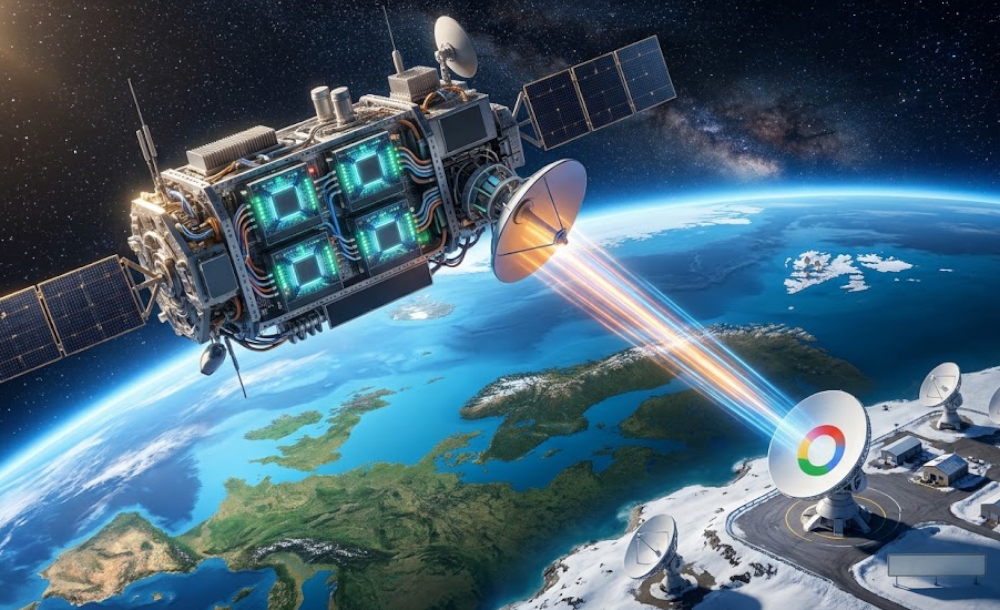
The journey began when an engineering team on Earth transmitted a request to an experimental satellite, which promptly replied with a short haiku composed by an advanced AI model onboard. This historic response occurred while the satellite was soaring above the Svalbard region in Norway, where the three-line verse captured the beauty of Earth and the majesty of space from the perspective of a silent electronic processor in orbit. This milestone follows the satellite's launch in October 2026, carried out in collaboration with Planet, a company specializing in aerospace imaging.
The Hardware: Trillium TPU Processors Confronting the Void
This satellite houses four chips from the Trillium TPU generation, which are Google's high-power processors dedicated to space technology and artificial intelligence operations. Due to limited power availability capped at just one kilowatt, only a single chip is powered on at any given time for intervals not exceeding 20 minutes. The open-weights Gemma 4 model was selected to act as the mastermind for this mission due to its high energy efficiency and capacity to deliver impressive results with minimal resources.
Project Suncatcher: Infinite Energy and Boundless Computing
Project Suncatcher aims to harness the unique advantages of space, where solar panels in orbit can generate up to eight times more energy than their terrestrial counterparts. This abundance of energy, combined with continuous sunlight, significantly reduces the need for massive storage batteries. Nevertheless, engineers still face formidable challenges, such as shielding memory modules from destructive cosmic radiation and dissipating heat within a vacuum environment that lacks the air required for conventional cooling.
The Future: A Laser-Linked Spatial Neural Network
Google's ambitions do not stop here; the company plans to launch two additional satellites in 2027. The upcoming objective is to test optical laser communications to link satellites together, enabling lightning-fast data transfers and the distribution of processing workloads across multiple spacecraft. This infrastructure will serve as the cornerstone for building scalable space data centers capable of running massive AI workloads far away from terrestrial congestion.
What is the primary purpose of sending artificial intelligence processors into space?
The purpose is to explore the feasibility of constructing space-based data centers that capitalize on the abundant and continuous solar energy available in orbit, thereby reducing reliance on Earth's resources and providing a unique operational environment for high-performance computing.
How does the satellite handle the issue of limited electrical power?
The satellite operates only a single TPU processor chip at any given time for a limited duration of up to 20 minutes, utilizing lightweight AI models like Gemma 4 which are specifically designed to perform efficiently with low power consumption.
What technical obstacles could threaten the success of space data center projects?
The prominent obstacles include cosmic radiation that can damage electronic circuits, the difficulty of dissipating excess heat in a vacuum, and the severe mechanical stresses and violent vibrations experienced by hardware during launch.
Will these satellites be connected to one another in the future?
Yes, Google plans to deploy laser communication technologies to link a constellation of satellites, allowing the distribution of complex processing operations among them and achieving ultra-high data transfer speeds that surpass conventional wireless technologies.
🔎 Google's successful operation of artificial intelligence in orbit represents a pivotal turning point in technological history, proving that the limits of human innovation are no longer confined to land or sea, but extend far into the vast reaches of space. Despite harsh technical and environmental challenges, achieving sustainable space data centers is closer than ever before, permanently transforming the landscape of computing and artificial intelligence.
Post a Comment